
About Behavior Online
Behavior Online aspires to be the premier World Wide Web gathering place for mental health professionals and applied behavioral scientists — a place where professionals of every discipline can feel at home.
Behavior Online was relaunched in 2013 as a place where leading experts in the behavioral health sphere could write, share and discuss topics of interest to the field. If you’re interested in writing or blogging on Behavior Online today, please contact us for further information. Guest posts are welcome.
Dedicated to its amazing founder, Gil Levin, Ph.D.
History of Behavior Online
Behavior Online first launched in 1995 as the premier meeting place for behavioral professionals, featuring a set of interactive discussion forums. Gilbert Levin, Ph.D. envisioned an online home where thought-leaders and leading experts in their respective field could come together to discuss, question and help further their schools of thought, practice, and techniques. He gathered together an impressive list of luminaries, who led discussions in their specific topic areas for years on the site.
Gilbert Levin passed away in March 2020. Behavior Online lives on in memory of Gil and will be renewed in 2023 under the direction of one Gil’s friends, John Grohol, Psy.D. We’d like to thank Alex Levin for his support of this effort.
Below, you will find the Editorial Board of the old Behavior Online. These names are listed for historical purposes only, and most do not have a current affiliation with the site.
| Editor and Publisher: | Gilbert Levin |
| Associate Editors: | John Grohol, Jon Schull, Jordan Schwartz |
| Consulting Editors: | James Brody, Jessica Broitman, Ellen Dornelas, Georg Eifert, Robert Feinstein, Barbara Fleming, Elkhonon Goldberg, Leonard Holmes, Vick Kelly, Marty Klein, Stephen Lankton, Cathy Malchiodi, Michael Miller, Scott Miller, Donald Nathanson, Brian O’Neill, Martin Perdoux, James Pretzer, William Reid, Larry Rosen, Charles Seashore, Francine Shapiro, James Spira, Henry Stein, John Suler, Johanna Tabin, Jeffrey Zeig |
| Founding Editorial Board: | Warren Bennis, Herbert Benson, Barrie Cassileth, Paul Levinson, Pedro Ruiz, Ernest Wolf |
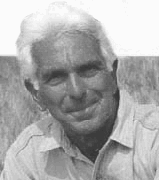 BOL: I hope our conversation will focus on the how-to of intervening in order to enhance the performance of organizations. You are a master of that art, but your most important work has focussed elsewhere: on understanding the nature of the organization,...
  BOL: Alfred Adler’s name is better known to today’s therapists than are his ideas and methods. Your dedication to this body of work must be based on the belief that contemporary practice is diminished because Adler’s contributions are not...